Traffic Moto Rider City
Safari MMSRacing
4.531.00 Reviews
- Version
- 1.2.2
- Installs
- 5.00M
- Age Rating
- Everyone
Screenshots
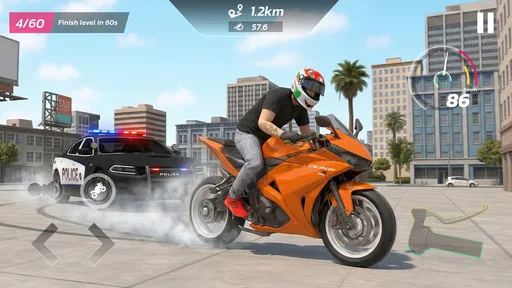
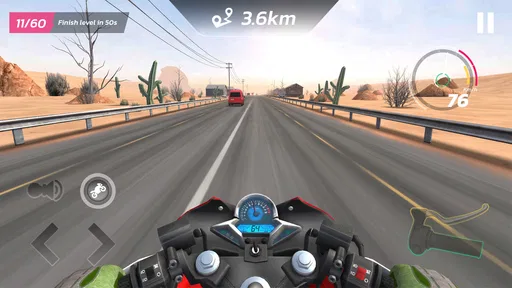
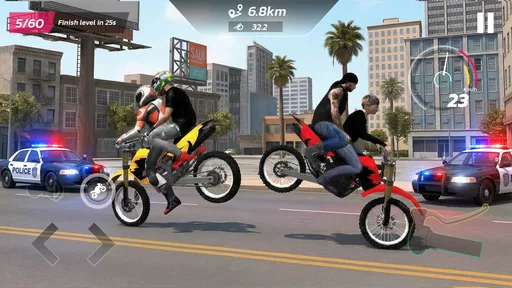
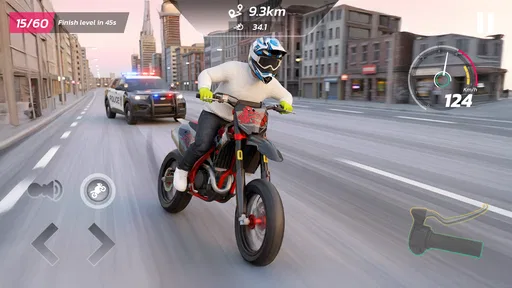
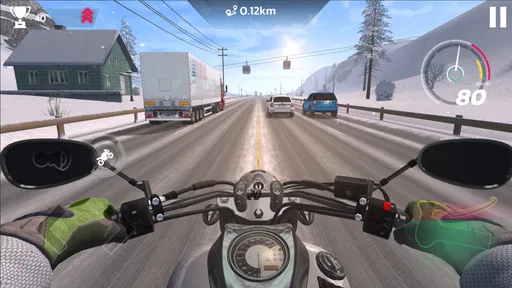
Our Review of Traffic Moto Rider City
 Analysis by Appyee
Traffic Moto Rider City is the kind of racing game I reach for when I want a quick burst of concentration rather than a long, structured campaign. I ride through busy city roads, react to traffic, and try to keep moving without losing control. The idea is easy to understand within seconds, but the challenge comes from turning that simple premise into a repeatable rhythm. It is free to download, aimed at Everyone, and developed by Safari MMS.
My overall impression is positive, although it depends heavily on what you expect from a mobile racer. This is not the best choice if you want a story, detailed vehicle tuning, or a large collection of carefully separated modes. It works better as an immediately playable traffic-dodging game: open it, make a few decisions, and see how long your run lasts. That directness is also important when considering different abilities and playing situations, because a simple control idea can be easier to approach than a game filled with menus and complicated systems.
How clear the game feels before the first ride
The strongest part of the experience is its low entry barrier. The central task is obvious: stay on the road, avoid obstacles, and continue through the city. I do not need to study a long tutorial or understand a complicated racing setup before playing. For someone who prefers learning by doing, that is a real advantage. The game communicates its purpose more clearly than many mobile racers that bury the actual driving under upgrade screens and event menus.
That simplicity also makes it suitable for short sessions. I can play while waiting for an appointment or during a brief break without needing to remember a storyline or prepare a vehicle. The game’s racing category is expressed through immediate movement and reaction rather than through a large simulation layer. If you enjoy quick attempts and gradual improvement in your own timing, the format is easy to appreciate.
At the same time, a straightforward structure can feel limited after repeated runs. Players who need constant variation may eventually want more than traffic patterns and longer roads. I would not choose this as my main racing game if I were looking for a deep career path or a highly organized competitive experience. Its appeal is concentrated in the ride itself, so the quality of each moment on the road matters more than the amount of surrounding content.
The current version is 1.2.2, and it runs on Android 7.0 or later. That broad compatibility is useful for people who keep an older phone instead of upgrading frequently. Still, compatibility alone does not guarantee the same comfort on every device. Screen size, touch response, brightness, and the way a phone is held can all affect how readable and manageable a fast traffic scene feels.
Reading the road without unnecessary effort
For me, the most important visual skill is separating the motorcycle’s path from the moving traffic and roadside scenery. I recommend beginning with a few deliberately cautious runs rather than immediately chasing distance. This lets me observe how much of the road remains visible at once and whether my eyes can comfortably track approaching vehicles. That small adjustment is more useful than simply increasing speed and hoping reaction time improves.
Players with reduced contrast sensitivity may find busy city scenes more demanding, especially when several objects overlap. I would suggest playing in a well-lit room, keeping the display clean, and avoiding reflections on the screen. Those are ordinary practical steps, but they can make a noticeable difference in a game where a brief visual mistake ends a run. I would also avoid judging the game in a rushed environment before deciding whether its presentation works for me.
The interface is easiest to approach when I treat it as a visual reaction task rather than as a menu-heavy application. If a player has difficulty reading small text or distinguishing close colors, the safer decision is to test the game for a short period and pay attention to fatigue. A game can be technically understandable while still being tiring to scan. That distinction matters here because the road demands repeated attention, not just a quick glance at a static screen.
Navigation that favors direct play
Traffic Moto Rider City benefits from not making the player navigate a maze before reaching the action. I can think of the game in two separate parts: getting into a ride and managing the road once it starts. The first part should be handled slowly, while the second rewards immediate reactions. Keeping that mental separation helps reduce mistakes caused by tapping quickly in the wrong place before a run begins.
This is also where the game may suit players who become overwhelmed by dense interfaces. A focused racing loop is less demanding than a title that combines garages, missions, social screens, upgrade trees, and several currencies. On the other hand, anyone who relies on highly adjustable menus may find the simpler design less accommodating. The experience is approachable because it avoids complexity, but that same choice can leave fewer ways to personalize the interaction.
I would not assume that a simple game is automatically comfortable for every player. People with motor, visual, or attention-related needs can experience the same controls very differently. My practical advice is to try a calm first session, use the device orientation that gives the best grip, and stop when the road begins to blur into a stream of forced reactions. The game is more enjoyable when I can make deliberate choices instead of merely trying to survive fatigue.
Motor demands, sensory load, and everyday play
The core challenge is built around timing and quick movement. I need to watch the traffic, predict an opening, and act before the available space disappears. That makes the game satisfying when my hands and eyes are working together, but it also creates a clear barrier for anyone who finds rapid touch input uncomfortable. The difficulty is not only mental; it is physical, because repeated small corrections can become tiring during a longer session.
For players with limited fine-motor control, the best approach is to treat each attempt as a short exercise rather than committing to a long marathon. I find that shorter sessions make errors easier to understand. If I fail because I reacted late, I can adjust my attention. If I fail because moving the phone or touching the screen is uncomfortable, that is a different problem, and playing longer will not solve it. Recognizing that difference prevents frustration.
One useful habit is to keep both hands available even if the game can be played with one. I can hold the phone more securely with one hand and use the other for input, which reduces the chance of an accidental movement caused by an unstable grip. This is not a special game feature, but it is a realistic way to make fast road decisions less physically awkward. It also helps when playing on a larger device that is harder to balance.
Someone with tremors or inconsistent touch accuracy may experience more difficulty than a player with quick reactions. In that situation, the game’s directness becomes a mixed advantage. There are fewer systems to learn, but the central action leaves little room for imprecise input. I would recommend trying it with the phone supported on a table or stable surface if that position remains comfortable. A stable setup can reduce unnecessary hand movement, though it may not suit every playing style.
Sound, motion, and concentration
Racing games can create sensory pressure through speed, movement, and repeated visual changes. Even when the rules are simple, a long run can require sustained concentration. I prefer playing with the sound at a comfortable level and taking breaks before the road begins to feel visually exhausting. Players who are sensitive to noise may want to use a quiet setting or keep the device volume low, while those who depend on audio cues should test whether the game remains understandable when played quietly.
I also think about motion sensitivity. A fast-moving road can be uncomfortable for some people, especially on a small screen held close to the face. I would test a few brief rounds while keeping the phone at a comfortable distance and stopping immediately if the movement causes discomfort. There is no benefit in forcing a session simply because the game is easy to start. The right test is whether I can play without physical strain, not whether I can endure it.
A realistic example is a commuter playing during a quiet wait at a station. The game may fit that moment because a run can be started without a major time commitment. However, a crowded platform, glare from overhead lighting, and frequent interruptions can make traffic prediction harder. In that setting, I would use it only when I can sit safely and focus on the screen. The same game that feels relaxing in a quiet room can become unnecessarily demanding in a moving or distracting environment.
Another useful scenario is a short evening session after work. I might have enough energy for a few attempts but not for a complex racing campaign. Here, the fast setup is a strength. I can play for a limited time, put the phone down, and return later without losing track of a long objective. If I am already mentally tired, though, the reaction-based design may feel more stressful than relaxing. A puzzle or slower game would be a better alternative on those nights.
Where it fits among mobile racing alternatives
Compared with a traditional simulation racer, this game asks for less preparation and offers a more immediate relationship between the player and the road. I do not approach it for realistic vehicle management or detailed race strategy. Its appeal is the repeated decision of when and where to move through traffic. That makes it more accessible to casual players, but less rewarding for anyone who wants mechanical depth.
Compared with kart-style racing games, it appears more focused on avoiding danger than on competing through a structured course. I enjoy that narrower objective when I want personal improvement rather than a full race with several opponents and items. The trade-off is that players who need varied characters, elaborate tracks, or a strong sense of event progression may find the experience too concentrated.
It also differs from endless runners that use a very small number of repeated lanes or gestures. Traffic Moto Rider City asks me to pay attention to a city-road situation, so the visual reading can feel more grounded than a purely abstract obstacle sequence. However, that extra visual information may increase the sensory and attention burden. A simpler runner could be better for someone who wants predictable patterns and minimal scene complexity.
The game is free, which makes trying it low-risk. There are in-app purchases ranging from $0.99 to $19.99 for each item. I would decide in advance whether I am comfortable spending money, especially because quick-session games can encourage repeated attempts. My preferred approach is to play the basic experience first and only consider a purchase if it clearly improves my enjoyment rather than compensating for frustration. That boundary is useful for casual players and for families sharing a device.
Situational access and the barriers that remain
The Everyone content rating makes the game approachable for a broad audience from an age perspective, but age suitability is not the same as universal ease of use. A younger player may understand the objective quickly, while an older player with slower reactions may need more time to become comfortable. Likewise, an experienced gamer may find the controls obvious, while someone unfamiliar with mobile racing may need a few low-pressure attempts to learn how the road behaves.
The game’s audience is also shaped by the device itself. A phone with a responsive screen and a comfortable grip can make the experience much more manageable than a device that is heavy, cramped, or difficult to hold. I would not evaluate the game only on a single ideal setup. If the screen is small, I would keep the display clean and avoid playing in glare. If the device is large, I would support it rather than trying to make fast movements while balancing it in one hand.
People who play with limited attention may appreciate the lack of a complicated story, but the road still requires uninterrupted focus. This is not a good game to play while walking, crossing a street, cooking, or handling another task. The obvious safety point is worth stating because the central mechanic encourages constant visual engagement. I would keep it for moments when I can sit down and give the screen my full attention.
For families, the free entry point and Everyone rating make it easy to let a child try a few rounds. I would still keep purchases in mind and decide who controls spending on the device. The most useful family rule is simple: enjoy the free play first, and treat optional spending as a separate decision. That keeps the game’s quick entertainment from turning into an unplanned purchase habit.
Who should choose it, and who should skip it
I think this is a good match for someone who wants a compact racing game with an instantly understandable objective. It suits players who enjoy improving reaction timing, prefer short attempts, and do not need a narrative reason to return. It can also work for people using an older Android phone, since the minimum operating system is Android 7.0 or later. The game has reached over five million installs and holds a 4.2 average from around 3.7 thousand ratings, which suggests that its straightforward format has found a sizable audience.
I would skip it if my priority were realistic racing physics, extensive customization, or a deep progression structure. I would also look elsewhere if fast visual movement regularly causes discomfort or if precise touch reactions are difficult. In those cases, a slower racing title, a turn-based game, or a runner with more predictable input may provide a better experience. Choosing another game is not a failure of this one; it is simply a better match between the control demands and the player.
Safari MMS has kept the concept focused, and that focus is both the game’s identity and its main limitation. There is value in not overwhelming the player with systems, but players who need adjustable controls, slower pacing, or more detailed accessibility options may want something with a broader settings menu. I would make that decision during the first session rather than after spending money, because the central control feel determines almost everything that follows.
My inclusive verdict after repeated short sessions
Traffic Moto Rider City is easiest to recommend as a focused, pick-up-and-play traffic racer. I like how quickly it explains itself and how naturally it fits into a spare few minutes. The road challenge can be satisfying without demanding a long commitment, and the free starting point makes experimentation simple. For many casual players, that directness will be more valuable than a large collection of features.
Its inclusive side comes from clarity and low setup effort, not from offering a solution for every possible need. Fast reactions, visual scanning, stable touch input, and tolerance for moving scenes still matter. I would play in short sessions, use a steady grip, avoid glare, and stop when concentration turns into strain. Those habits do not change the game, but they make it easier to judge fairly in real life.
My final recommendation is therefore selective but positive. If you want a free city-road racing game for brief, focused attempts, this is worth trying. If you need deep customization, gentle pacing, or extensive control adjustments, I would choose a different mobile racer. For the right player and the right setting, Traffic Moto Rider City delivers a clean, uncomplicated challenge that is easy to start and honest about what it wants you to do: watch the road, make a quick decision, and try again.
Privacy and Permissions
See what permissions an app requests and how it handles your data.
- Wi-Fi connection information
- view Wi-Fi connections
- Other
- view network connections, full network access, control vibration, prevent device from sleeping
Verdict
Strengths of Traffic Moto Rider City
- Smooth motorcycle controls that are easy to learn
- Several city routes offer varied traffic challenges
- Motorcycles provide different handling experiences
- Works well for short, quick gaming sessions
- Offline play is useful when no internet is available
Limitations of Traffic Moto Rider City
- Ads may interrupt gameplay between races
- Some bikes and upgrades require significant grinding
- Traffic patterns can feel repetitive after extended play
- Limited customization reduces long-term personalization
- Performance may vary on older or budget devices
Other Releases by Safari MMS
View All
Real Traffic Car Simulator 3D
Racing4.4

Car Driving & Parking Academy
Racing4.6
Similar Picks in This Category
View All
Hill Climb Racing
Fingersoft4.3

Dr. Driving
SUD Inc.4.2

Traffic Rider
skgames4.5

Asphalt 8 - Car Racing Game
Gameloft SE4.6

Race Master 3D: Car Racing
Beresnev Games4.6

Extreme Car Driving Simulator
AxesInMotion Racing4.3
Frequently Asked Questions
What is Traffic Moto Rider City?
Traffic Moto Rider City is a motorcycle racing game focused on riding through busy urban roads while avoiding cars, buses, and other traffic. It typically combines endless or mission-based driving with bike upgrades, changing city environments, and score-based challenges. The main appeal is its fast-paced gameplay, where timing, lane changes, and controlled overtaking are more important than simply driving at top speed.
How do you play Traffic Moto Rider City?
The basic gameplay is easy to understand: choose a motorcycle, accelerate through city traffic, and avoid collisions for as long as possible or until you complete the assigned objective. Depending on the mode, you may need to travel a certain distance, reach a target score, or finish a challenge. Steering and braking require quick reactions, especially when vehicles change lanes unexpectedly.
Does Traffic Moto Rider City work offline?
Traffic Moto Rider City may offer offline access to its main driving modes, which is useful when you are traveling or do not have a stable internet connection. However, features such as advertisements, rewarded bonuses, cloud synchronization, online rankings, or updates may require connectivity. It is best to launch the game once online and check which modes and rewards remain available without an internet connection.
Is Traffic Moto Rider City free to download and play?
Traffic Moto Rider City is generally available as a free download, but the experience may include advertising and optional in-app purchases. Players can often earn coins or rewards through regular gameplay, while purchases may speed up bike upgrades or unlock additional content. Before downloading, check the store listing for the current pricing, supported devices, and any purchase-related information.
Does Traffic Moto Rider City require a powerful phone?
The game is designed for mobile devices, but performance can vary depending on your phone or tablet. Older devices may experience slower loading, reduced frame rates, or occasional stuttering, particularly when traffic density and visual effects are high. For smoother gameplay, keep enough free storage available, close unnecessary background apps, and use lower graphics settings if the game provides that option.
Play our best games!


